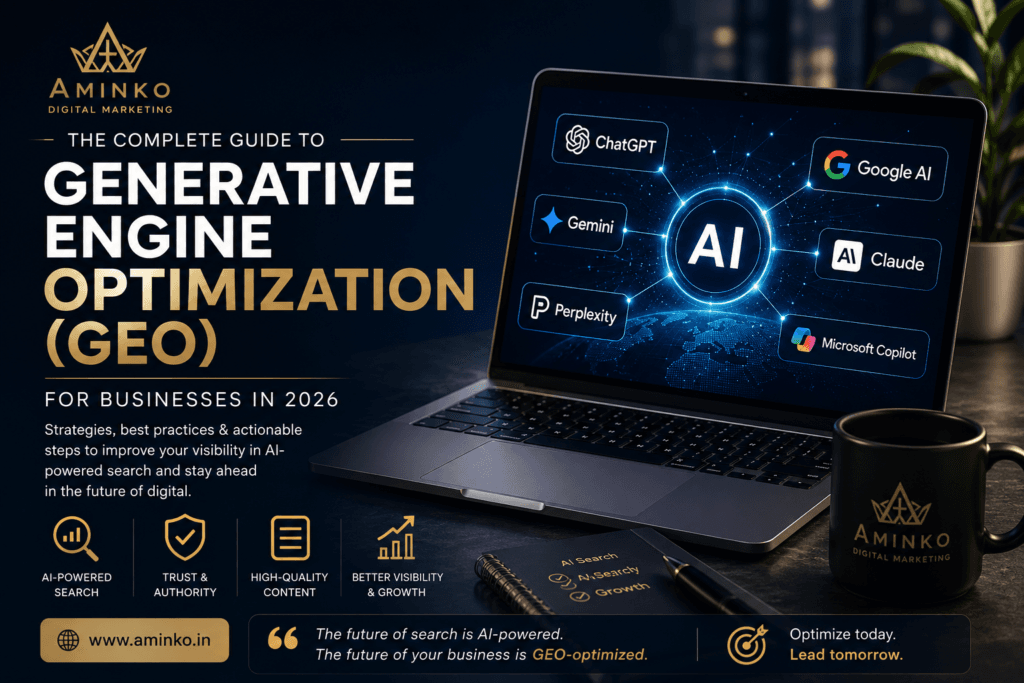
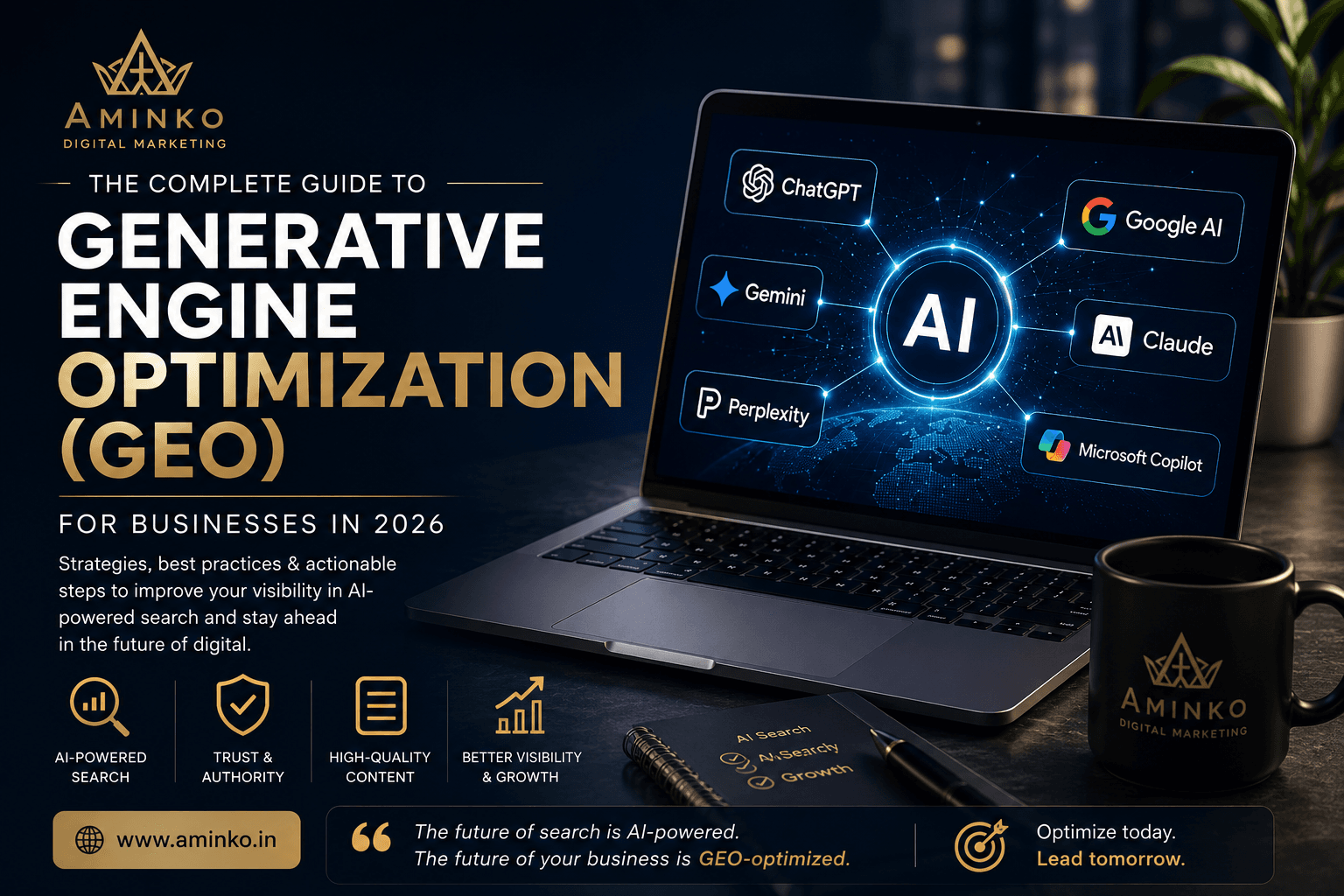
Generative Engine Optimization (GEO): The Complete Guide for Businesses in 2026
Artificial intelligence has changed the way people search for information online.
A few years ago, most users opened Google, typed a keyword, and clicked through several websites before finding the answer they needed. Today, that journey looks very different. Millions of people now ask ChatGPT, Gemini, Claude, Perplexity, and Google’s AI-powered search experiences for direct answers instead of browsing through multiple pages.
This shift has created a new challenge for businesses.
If AI assistants are answering users’ questions directly, how can your business become one of the trusted sources they rely on?
The answer isGenerative Engine Optimization (GEO).
While traditional SEO focuses on ranking web pages in search engines, GEO is about making your content understandable, trustworthy, and valuable enough for AI systems to reference, summarize, and recommend.
For businesses that want to remain visible in 2026 and beyond, GEO is no longer optional. It is becoming a critical part of every successful digital marketing strategy.
In this guide, you’ll learn:
- What Generative Engine Optimization (GEO) really means
- How GEO differs from traditional SEO
- Why AI search is changing digital marketing
- Practical strategies to optimize your website for AI-powered search engines
- Common GEO mistakes to avoid
- The future of search in an AI-first world
Whether you own a local business, manage an eCommerce store, or run a digital marketing agency, understanding GEO today will give you a competitive advantage tomorrow.
What is Generative Engine Optimization (GEO)?
Generative Engine Optimization (GEO) is the process of creating and structuring website content so that artificial intelligence systems can easily understand, trust, and use it when generating answers for users.
Unlike traditional search engines that primarily rank pages based on relevance and authority, AI systems analyze information from multiple trusted sources before creating a conversational response.
Instead of simply asking,
“Which website ranks #1?”
AI models ask questions like:
- Which source is the most reliable?
- Is the information accurate?
- Does the content answer the user’s question clearly?
- Is the information up to date?
- Can multiple trusted sources support the same answer?
If your content satisfies these requirements, AI platforms are more likely to reference your website when generating responses.
This is exactly where GEO comes in.
Rather than focusing only on rankings, GEO focuses on becoming a reliable knowledge source for AI-powered search.
Why GEO Matters More Than Ever in 2026
Search behavior is changing faster than many businesses realize.
People increasingly expect immediate, conversational answers instead of long lists of search results.
Instead of typing:
Best digital marketing agency for startups
Users now ask:
Which digital marketing agency is best for a startup with a limited budget?
Or,
How can I improve my website’s visibility in AI search results?
These are natural language questions—and AI search engines are designed to answer them directly.
For businesses, this changes everything.
Visibility is no longer limited to Google’s first page.
Your content now has the opportunity to appear inside AI-generated responses across multiple platforms.
Businesses that ignore this shift risk losing valuable traffic, even if they continue ranking well in traditional search results.
Those that embrace GEO position themselves to stay visible wherever users search.
The Rise of AI Search
Artificial intelligence has fundamentally changed online search.
Instead of presenting ten blue links, AI systems now combine information from multiple trusted sources to generate a complete answer.
This creates a better experience for users because they receive:
- Faster answers
- Personalized responses
- More conversational explanations
- Better context
- Follow-up recommendations
For website owners, however, it means content must be written differently.
Generic articles filled with keywords are becoming less effective.
AI prefers content that demonstrates expertise, solves real problems, provides original insights, and is easy to understand.
That’s why businesses should think beyond keywords and begin optimizing for AI comprehension.
Learn more about how Google Search works in the official Google Search documentation.
GEO vs SEO: What's the Difference?
One of the biggest misconceptions is that GEO will replace SEO.
It won’t.
Instead, GEO builds on the foundation of strong SEO.
Think of SEO as helping people discover your website.
Think of GEO as helping AI understand and trust your content.
|
Traditional SEO
|
Generative Engine Optimization (GEO)
|
|---|---|
The most successful businesses in 2026 won’t choose between SEO and GEO.
They’ll combine both.
SEO helps users find your website.
GEO helps AI recommend it.
Together, they create a future-ready digital marketing strategy.
Why Businesses Should Start Optimizing Today
Many companies still believe AI search is something to think about later.
That assumption could become costly.
Just as businesses that adopted SEO early gained years of competitive advantage, the same opportunity exists with GEO today.
Early adopters are already building content that AI systems recognize as trustworthy.
As AI search continues to grow, these websites will likely gain more visibility, stronger authority, and better long-term traffic than competitors who wait.
For businesses, Generative Engine Optimization (GEO) isn’t just another marketing trend. It represents the next evolution of search and a new way for brands to build visibility across AI-powered search platforms.
How AI Chooses Which Websites to Trust
One of the biggest misconceptions about AI-powered search is that it works exactly like Google did a few years ago. It doesn’t.
Traditional search engines rank pages based on hundreds of signals, such as backlinks, page speed, keyword relevance, and user experience. AI models, however, go a step further. They don’t just look for the highest-ranking page—they look for the most trustworthy and useful information.
When someone asks ChatGPT, Gemini, or Google AI Mode a question, these systems aim to provide the most accurate, well-structured, and reliable answer possible. To do that, they evaluate content using a combination of quality signals rather than relying on a single ranking factor.
Here are some of the key elements AI systems consider:
- Topical expertise: Does the website consistently publish high-quality content on the subject?
- Content accuracy: Is the information factually correct and up to date?
- Authority: Is the website recognized as a credible source within its industry?
- Content structure: Is the information easy to understand with clear headings, lists, and logical organization?
- User value: Does the content genuinely answer the user’s question instead of simply targeting keywords?
The goal isn’t to write for AI—it’s to write for people in a way that AI can easily understand and trust.
How ChatGPT, Gemini, and Google AI Mode Evaluate Content
Although every AI platform has its own way of processing information, they all prioritize one thing: helpful, trustworthy content.
ChatGPT
ChatGPT is designed to provide conversational answers rather than lists of links. It tends to favor content that:
- Explains concepts clearly
- Uses simple, natural language
- Includes practical examples
- Covers a topic comprehensively
- Demonstrates expertise and credibility
Content that reads like it was written by a real expert is far more valuable than content stuffed with repetitive keywords.
Google AI Mode
Google AI Mode combines traditional search ranking signals with AI-generated responses.
It values websites that already follow strong SEO fundamentals, including:
- Fast loading speed
- Mobile-friendly design
- Helpful content
- Strong internal linking
- High-quality backlinks
- Updated information
If your website already performs well in Google Search, you’re in a strong position to improve your visibility in AI Mode by enhancing your content quality.
Gemini
Gemini focuses on context and user intent. Instead of matching exact keywords, it tries to understand what the user actually wants.
For example, if someone searches:
“How can a small business appear in AI search results?”
Gemini is more likely to recommend content that explains the process step by step, includes actionable advice, and answers related questions—all in one place.
Perplexity AI
Perplexity is known for citing its sources. It often references websites that provide:
- Original research
- Expert insights
- Statistics
- Case studies
- Well-documented information
If your content includes credible data and supports its claims with reliable references, it has a better chance of being cited.
Claude AI
Claude emphasizes clarity, depth, and trustworthiness. Long-form articles that avoid unnecessary jargon and provide balanced, factual explanations tend to perform well.
12 Proven GEO Strategies Every Business Should Implement
Now that you understand how AI evaluates content, let’s look at the Generative Engine Optimization strategies that can improve your visibility across AI-powered search platforms.
1. Write for Humans First
The best-performing content in 2026 is written for people—not algorithms.
Avoid creating articles just to insert keywords. Instead, focus on solving real problems and answering real questions.
A conversational tone, clear explanations, and practical advice will always outperform robotic writing.
2. Cover Topics Completely
Instead of publishing multiple short articles around similar keywords, create comprehensive guides that answer every important question about a topic.
For example, rather than writing separate posts about:
- What is GEO?
- GEO vs SEO
- GEO strategies
Combine them into one in-depth resource that becomes the go-to reference.
This approach helps establish topical authority and increases the likelihood that AI systems will view your content as a trusted source.
3. Use Clear Heading Structures
AI systems understand content better when it’s well organized.
Use a logical hierarchy like this:
- H1 for the main topic
- H2 for major sections
- H3 for supporting points
Clear headings improve readability for both users and AI.
4. Answer Questions Directly
AI models often extract concise answers from web pages.
Whenever possible, answer common questions within the first few sentences of a section before expanding on the topic.
This makes your content easier to reference in AI-generated responses.
Optimize Your Website for AI Search
After understanding the fundamentals of GEO, the next step is making your website easier for AI systems to understand and trust. Here are a few practical techniques that can significantly improve your visibility.
Use Schema Markup
Structured data helps search engines and AI platforms understand the context of your content. Adding schema types such as Article, FAQ, Organization, and Breadcrumb can improve how your pages are interpreted and displayed in search results.
You can learn more about structured data from Google’s official Schema documentation.
Publish Original Insights
AI platforms prioritize unique and valuable information. Instead of repeating what every other website says, share original case studies, industry observations, client success stories, or practical tips based on real experience. Original content is far more likely to earn trust and citations.
Keep Content Updated
AI prefers fresh and relevant information. Review your important pages regularly to update outdated statistics, add new examples, and improve sections based on changing trends. A well-maintained article signals reliability.
Improve Internal Linking
Connect related pages across your website to build topical authority. For example, if you publish content about SEO, AI marketing, or content strategy, link those articles naturally within your GEO guide. This helps both readers and search engines understand the relationship between topics.
Focus on User Experience
A fast, mobile-friendly, and easy-to-navigate website creates a better experience for visitors. Clear layouts, readable formatting, secure HTTPS, and quick loading times all contribute to higher trust and stronger performance in both traditional and AI-powered search.
Common GEO Mistakes to Avoid
Even well-written content can struggle if it overlooks the basics. Avoid these common mistakes when optimizing for AI search.
- Writing only for keywords: Keyword stuffing makes content harder to read and reduces its value.
- Publishing generic AI-generated articles: Content that lacks original insights rarely stands out.
- Ignoring search intent: Focus on answering real user questions instead of targeting keywords alone.
- Poor content structure: Use descriptive headings, short paragraphs, and bullet points to improve readability.
- Never updating old content: Outdated information can reduce credibility and trust.
GEO Checklist for 2026
Before publishing any article, ask yourself:
- ✔ Does it answer the user’s question clearly?
- ✔ Is the information accurate and up to date?
- ✔ Have you used descriptive headings and short paragraphs?
- ✔ Does the page include internal links to related content?
- ✔ Have you added relevant schema markup?
- ✔ Does the article demonstrate expertise and real-world value?
- ✔ Is the content easy to read on both desktop and mobile?
If you can answer yes to most of these questions, your content is well-positioned for both search engines and AI-powered search.
Conclusion
Generative Engine Optimization isn’t replacing SEO—it’s expanding it. As AI-powered search becomes a bigger part of how people discover information, businesses need to create content that is not only optimized for search engines but also trusted by AI systems.
The foundation remains the same: publish accurate, helpful, and well-structured content that genuinely solves users’ problems. By combining traditional SEO best practices with GEO strategies, you’ll improve your chances of appearing in AI-generated answers while continuing to grow your organic visibility.
The future of search is already here, and businesses that adapt today will be better prepared for tomorrow.
GEO is the process of optimizing content so AI-powered search tools like ChatGPT, Gemini, and Google AI Mode can better understand, trust, and reference your website.
No. GEO complements SEO. While SEO helps your pages rank in search engines, GEO improves your chances of being included in AI-generated answers.
Absolutely. By creating helpful, authoritative content and maintaining a well-structured website, small businesses can improve their visibility in both traditional and AI-powered search.
Focus on clear content structure, EEAT, schema markup, original insights, strong internal linking, and regularly updated content.